







Introduction
Teletactica, a Ukrainian-Estonian defense-technology startup, recently closed a $1.5 million seed funding round. The round was co-led by MITS Capital, an investment group focused on Ukrainian defense innovation, and Green Flag Ventures, a US-Ukraine venture firm specializing in dual-use and AI technologies. The funding will support production scaling, European expansion, and enhancement of Teletactica’s communication systems for frontline use. These systems are designed to maintain data and voice connectivity in electronic-warfare-intensive environments, GPS-denied areas, and low-infrastructure zones. The round follows Teletactica’s participation in the MITS Capital Acceleration Program and a prior pre-seed financing, and marks a transition toward broader deployment across Ukraine and beyond.
Company Profile
Founded in 2023 by industry professionals including a chief executive and a chief technology officer, Teletactica focuses on developing modular, ruggedized communication systems for defense applications. The team draws experience from engineering, military standards, and telecom domains. Operating within the Brave1 defense-tech innovation cluster, the company benefits from ecosystem support connecting it with government, manufacturing partners, and fellow startups. Its funding to date remains within early-stage levels, with the most recent $1.5 million round representing its first significant external financing. The company continues to operate from Ukraine while targeting broader geographic deployment and building out its operational infrastructure.
Technology
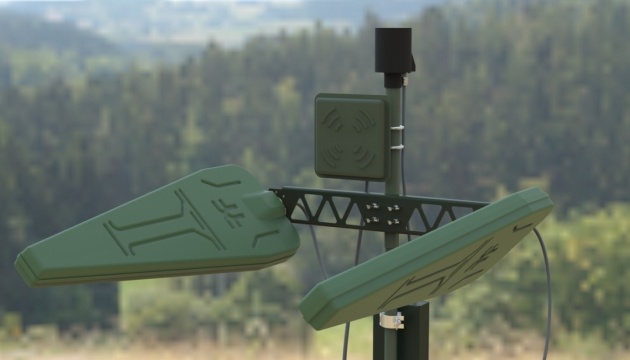
Teletactica’s core offering is a suite of communication modules designed for unmanned aerial vehicles (UAVs), unmanned ground vehicles (UGVs), and other mobile defense platforms operating under intensive electronic warfare conditions. Its systems are built to ensure encrypted data and voice transmissions remain stable even under active jamming, infrastructure disruption, or GPS denial. The modular design includes video and telemetry modems, compact antenna kits, and low-latency data links with minimal packet loss—hitting rates as low as 1–5 percent under interference. The technology prioritizes scalability, affordability, and field deployment at scale.
Teletactica hardware is compact and low-power, making it suitable for integration into small, power-constrained unmanned systems. This allows defense units to deploy the technology in large numbers. The company maintains price-to-performance advantages over comparable radios manufactured in the EU and US, supporting broader adoption across frontline units. The systems are adapted to NATO standards, enabling interoperability.
By participating in the MITS Acceleration Program and the Brave1 cluster, Teletactica has refined its production pipeline. The latest funding will enable the ramping up of manufacturing, quality testing, and logistics operations. It will also support technical enhancements to improve resilience and latency in challenging environments, as well as certification pathways needed for European clients.
Company Outlook
With fresh funding secured, Teletactica is positioned to move from prototype and limited production toward scalable deployment. The next stage involves validating systems in combat-like conditions, formalizing supply chains, and initiating targeted sales in European defense markets. Continued involvement in investor networks and industry clusters will help the company access institutional contracts and integration opportunities. Teletactica’s challenge will be balancing quality and cost while responding rapidly to evolving battlefield requirements.
Competition
Teletactica operates in a competitive defense-communications space that includes both regional and international firms developing jamming-resistant, secure radio systems. Regional competitors include Himera, which provides interoperable rugged communication modules, and Laser Guard Systems, offering autonomous intrusion detection with resilient air links. On a broader scale, Western manufacturers such as Thales, Collins Aerospace, and Raytheon develop high-end tactical radios for military platforms, often with broader feature sets and larger production capacities. Other defense-tech startups like Drone Defence UK and Granta Autonomy focus on UAV communication suites, while companies like Milrem Robotics include integrated comms systems in their unmanned ground systems. Teletactica’s differentiation lies in its low-cost, modular systems optimized for rapid mass deployment and resilience under jamming, tailored to unmanned platforms. Its success will depend on demonstrating performance in real-world deployments, securing institutional buyers, and scaling production while maintaining competitive margins.