








Introduction
Rheinmetall AG, a major player in the global defense and automotive sectors, has moved to acquire Hagedorn-NC GmbH, a German manufacturer specializing in industrial nitrocellulose. The acquisition marks a strategic effort by Rheinmetall to reinforce its control over critical raw materials necessary for propellant production—an essential component in ammunition manufacturing. This move underscores broader industry dynamics where securing supply chain resilience has become a competitive necessity amid heightened geopolitical tensions and increased defense spending across Europe.
Deal Details
The transaction involves the acquisition of Hagedorn-NC GmbH from its parent company, Hagedorn AG. Although financial specifics have not been disclosed, the deal includes the full transfer of operations, facilities, and the retention of the company’s approximately 90 employees. Hagedorn-NC will be integrated into Rheinmetall’s existing ammunition and propellant operations. The transaction remains subject to regulatory approval by competition authorities, with both parties expressing confidence in a smooth closing process.
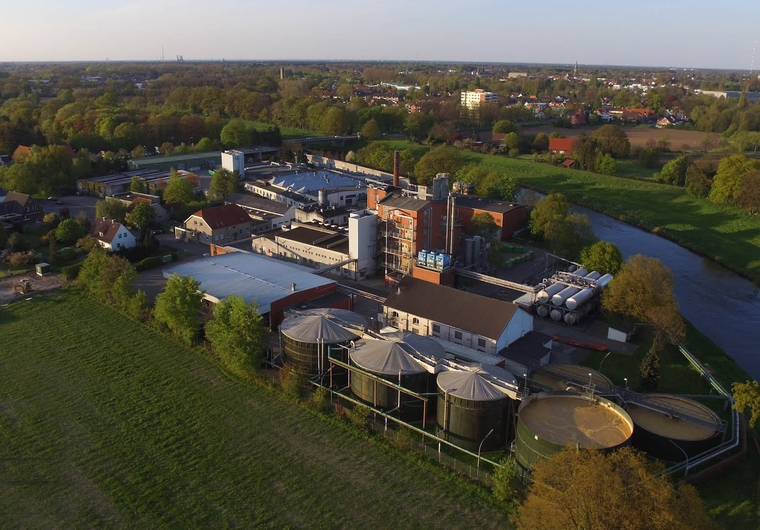
The acquisition includes Hagedorn-NC’s production site in Lingen (Ems), Lower Saxony, a region that has played a significant role in German industrial production. Through this move, Rheinmetall ensures both capacity and continuity, adding a critical domestic production node to its supply network.
Deal Rationale
The primary rationale behind the acquisition is strategic: Rheinmetall aims to alleviate a key bottleneck in its ammunition production process by gaining direct control over its nitrocellulose supply. Nitrocellulose is a volatile, highly regulated substance that is foundational to propellant manufacturing. Given the increased demand for munitions driven by NATO member rearmament and the ongoing conflict in Ukraine, reliable access to such a material is critical.
By acquiring Hagedorn-NC, Rheinmetall reduces its dependence on external suppliers, mitigates supply chain risks, and positions itself to scale production more responsively. The deal also reflects a broader trend among defense contractors to internalize key production capabilities amid uncertain global supply chains and increased scrutiny on import dependencies for defense-critical materials.
Target Profile: Hagedorn-NC GmbH
Founded in 1910, Hagedorn-NC GmbH has over a century of experience in the production of industrial nitrocellulose. The company has built its expertise in a niche yet critical segment of the chemical industry, serving both defense and civilian markets. Operating primarily out of its facility in Lingen (Ems), Hagedorn-NC is recognized for maintaining high production standards and the ability to deliver tailored solutions to customers with specific technical requirements.
While its footprint has remained largely regional, Hagedorn-NC’s role in the broader munitions ecosystem is significant, as it has maintained steady production volumes even as global demand has fluctuated. Under Rheinmetall, the company is expected to scale operations while aligning more closely with military-grade standards and supply priorities.
Acquirer Profile: Rheinmetall AG
Headquartered in Düsseldorf, Rheinmetall AG is one of Germany’s most prominent industrial and defense conglomerates. With origins dating back to 1889, the company has grown into a global leader in military vehicles, weapons systems, and ammunition, while also maintaining a strong presence in the automotive components sector.
Rheinmetall operates through two primary segments: Defense and Automotive (also known as Rheinmetall Power Systems). The company has increasingly focused on strengthening its defense portfolio, capitalizing on rising global military expenditures and the demand for modernized ground systems, artillery, and ammunition.
The acquisition of Hagedorn-NC is part of Rheinmetall’s ongoing strategy to build a vertically integrated munitions manufacturing capability. By owning key suppliers and producers within its value chain, Rheinmetall is better equipped to meet urgent contract demands from European governments and NATO allies.
Competition Overview
Rheinmetall operates in a highly competitive global defense landscape. Key rivals include U.S.-based defense giants such as General Dynamics, Northrop Grumman, and Lockheed Martin, as well as European firms like BAE Systems, Leonardo, and KNDS (the KNDS group formed by Krauss-Maffei Wegmann and Nexter). While these companies compete across various segments—ranging from armored vehicles and precision-guided munitions to electronic warfare and missile systems—the ability to scale ammunition production has become a particularly strategic differentiator.
The acquisition of Hagedorn-NC gives Rheinmetall an advantage in ensuring the stability and scalability of its propellant supply, particularly at a time when competitors remain reliant on fragmented supplier ecosystems. As defense budgets grow and governments seek faster delivery timelines, control over raw materials will likely become an increasingly decisive factor in competitive bidding and long-term contracts.
Conclusion
Rheinmetall’s acquisition of Hagedorn-NC GmbH is a calculated step toward consolidating its munitions supply chain, reducing external dependencies, and preparing for long-term growth in a rapidly evolving defense landscape. With increasing geopolitical pressures and rising demand for reliable defense production capabilities, the deal reinforces Rheinmetall’s position not only as a manufacturer but also as a vertically integrated, strategically autonomous defense supplier. Once approved, the integration of Hagedorn-NC will likely serve as a model for similar moves by competitors seeking to control critical input materials and ensure operational continuity in a volatile global environment.